Knitting

Moss Stitch Cardigan

I was delighted to learn my cousin Neil and his girlfriend were expecting a baby and immediately bought the yarn to make one of my favorite patterns for little ones. This sweater is the Moss Stitch Cardigan from the book Double Knits by Zoe Mellor. The book was published in 2000, but the patterns hold up. (I will note that there are numerous mistakes in the patterns, so if you buy a copy of the book, beware).

I chose to use Cotton Glace yarn by Rowan. I ordered it straight from the Rowan site as my local yarn store doesn’t carry their yarn and Jimmy Beans, the online site I frequently buy from, doesn’t offer this particular yarn. I found the Rowan site to be user-friendly and lucky for me, the shipping was free because I met the minimum purchase amount ($50) for that benefit.

As I alluded to before, I’ve made this pattern in the past and it’s come out well. I used Cotton Glace then as well. Unfortunately Rowan has discontinued the yarn recommended in the pattern and I had to go online to double-check the gauge. With the Cotton Glace, I found the gauge to be different than the recommended yarn, but with baby sweaters, that isn’t always a concern. They’re going to outgrow their sweaters soon enough regardless!

I made the 1-2 year old size and it fit baby Arnie from about the age of 8-13 months. With the gauge difference, the sweater was smaller, and Arnie turned out to be a big baby.

I found some really cute buttons on Amazon with a “under the sea” theme. Just a warning about buying buttons this way–I ended up with 100 buttons, far more than I could use. Based on the cost, which was pretty low, I had no idea there would be that many, but now I have buttons for the next baby sweater I make, I guess.

Moss stitch can be tedious and this sweater had little shaping, but I found it went pretty fast. The book is out of print, but Amazon had some for a good price. As I mentioned before, many of the patterns have mistakes, although I didn’t find any for this particular pattern.

Knitting

Woven Roots Scarf

Well, this is the second of four scarves I’m knitting for Christmas gifts, all going to my brother and his family. I love this pattern so much I’m making another scarf–the fourth one–with the same design. It knit up quickly and the pattern is easy to memorize.

Speaking of the pattern, it’s the Woven Roots Scarf by Brooklyn Tweed, designed by Jared Flood. I found it on Ravelry, although Brooklyn Tweed has their own web site where you can buy any number of patterns. In fact, they’re less expensive if you buy them on their web site (something I found out too late, but hey, it was only a dollar difference). The recommended skill level is “adventurous beginner” and I guess I’d place it there. I’d suggest having some experience with cables, but it wouldn’t take much.

The pattern is free if you buy at least four skeins of worsted weight yarn from Brooklyn Tweed, but I noticed on Ravelry that at least one person who knit the scarves up with BT’s yarn wasn’t happy with it. If they used the suggested yarn they seemed to like it, but other worsted weights didn’t work as well.

I found the pattern to be well-written and easy to follow. As I mentioned earlier, it’s also easy to memorize, so you don’t have to follow the chart for every row.

I used Cascade 220 in color 9473 Gris–NOT the machine washable kind. It was perfect for this scarf and should be warm and comfortable for whichever member of my brother’s family chooses to wear it. It’s the same yarn I’m knitting all four scarves in, and I’ve been very happy with both the knitting experience and the finished product.

The pattern suggested size 5 needles for the beginning and end ribbing, but I used size 6, which worked out very well. I did use the recommended size 8 needles for the body of the scarf, and it knit to gauge.

Blocking was super easy as there weren’t really any adjustments I needed to make to get the pattern to size. For other scarves I’ve had to stretch them out size, but not this one.

Like the other scarves I’m knitting, this one ended up with a lot of cat hair in it. I have two cats who generously shed and it just can’t be helped. However, I don’t notice as much in this scarf as I did in the one I knit just before this with a different pattern.

I can’t wait to give this to my brother for Christmas!!!

Knitting

Blue Riley Scarf

Christmas is fast approaching. While my family isn’t big on giving gifts, we do exchange some, and I decided that this year I’d make my brother a scarf. (I plan to make one for my sister-in-law as well, but I haven’t even gotten the yarn for that one so look for it in a future post.) I chose the Riley Scarf by SweaterBabe.com.

Overall, I’m really pleased with this scarf. You’ll have to excuse the amount of cat hair in it. My cats loved sitting on the work in progress, plus, with two of them, I simply have a ton of cat hair in my apartment and no amount of vacuuming or other cleaning is going to get rid of it. I’ll continue to try to pick it out before I send it, but my brother has cats as well and he’ll understand.

The pattern, as I mentioned earlier, is from SweaterBabe.com and is well-written, with a clear chart as well as written instructions. The cable panels are the same pattern, but they’re staggered. I strongly recommend having a row counter to keep track of which row you’re on. The pattern is not difficult. I’d recommend it for anyone with basic cable experience.

I chose Cascade 220 yarn in color 4009 Aporto. Remarkably, the color in the picture is very true to the real color (if you follow my blog at all, you’ll know that that’s the exception to the rule when it comes to my camera). This isn’t the superwash yarn, so the scarf will have to be hand washed, but how often does one wash a scarf? I love the color, although it was a little dark to work with and I needed good lighting to follow my knitting.

I chose Addi Original Turbo size 8 16″ circular needles. Addi’s are my favorite needles to work with. The finish is smooth and the yarn just glides over it. Size 8 is the recommended size for the scarf and I knit true to the gauge in the pattern.

There is a wrap in the pattern that’s very simple, but getting the tension right proved a little difficult. At first I looped the yarn in the wrap somewhat loosely, but that didn’t work well and in the end I was wrapping it a little snugger. I recommend playing with this in your swatch to get it right.

The only problem I had with this scarf was getting the edges to lie flat. It took a lot of blocking and I never really succeeded as I would have liked to. Still, I’m very happy with the finished product.

If you’re looking for a pretty scarf pattern that knits up quickly and is striking in design, I recommend this one.

Image Credits: Scarf © Belinda O; Christmas Cat Tree © Aksana–stock.adobe.com

Knitting

Madison Cable Cardigan

It may look like I haven’t been knitting in awhile, but I have. Just no posts (yet) for three of the four projects I’ve finished since May. I miss the days when I would have completed two or three times that number in five months, but I’m just not able to knit as much these days.

Anyhow, my latest project is this cardigan from SweaterBabe.com. The pattern is called Madison Cabled Cardigan. You can purchase the pattern at that site, along with any number of other really cute patterns. The patterns for the two baby blankets I knit for Hlie (I have yet to complete my post for the second) come from there, as well as the patterns for a couple of shawls I’ve made. So I can vouch for the ease in reading their patterns. Most of them have charts as well as written instructions, and that includes the pattern for this cardigan.

However, I was disappointed in one thing about this pattern. The sweater in the pattern picture is definitely longer than the one I completed, and I knit to gauge. If you choose to make it and want it as long as what is pictured on the pattern, I’d recommend buying an extra skein or two and measuring carefully as you go.

Because the sweater is so short, I’ll probably wear it mostly around the house, but I always need a good sweater since I keep the thermostat low in the winter. Don’t get me wrong, it’s really cute, just really short, and hits me in a bad spot.

I used Rowan Pure Wool Superwash Worsted in Rich Red. The picture I have of the whole sweater is closer to the real color than the close-up of the stitches I have below. I had enough left over to make a hat for a toddler, and I tossed that hat in the washer to see how the yarn looked once I’d washed it. Well, that was another disappointment. The yarn got very fuzzy when I washed it and I chose not to dry it in case it got worse. That hat was knit for a local charity and I’m a little embarrassed to give it to them since it looks like it was worn. I won’t be washing the sweater in the washer.

The pattern is listed as being appropriate for an intermediate knitter, and I agree with that classification, although I wouldn’t recommend it for someone who hasn’t done cables before. The sleeves are a different stitch pattern than the body of the sweater in that they only have the lace portion. I found them to be quite easy to knit.

I did find the lace stitches got a little lost in all the cable stitches, but that isn’t really distracting in the final product. However, while knitting I kept thinking I’d missed a lace stitch.

One thing I’d recommend that the pattern doesn’t suggest is to place markers between each pattern repeat. There are twelve stitches in a pattern repeat, so you’ll need a fair number of markers, but it’s worth it.

I used 24″ size 8 Addi Ewenicorn circular needles, the size recommended for the pattern. I definitely recommend doing a swatch first, but of course you always should do that. Once again I love the Ewenicorn needles. Not sure exactly what the difference is, but they make me happy.

Overall, I’m really happy with this sweater. I just wish it were a little longer. I would have ordered more yarn, but what I got was the last of that dye lot and red is a difficult color to match.

Knitting

Fancy Cables and Lace Blanket

My friend Hlie (Lee) from work is having baby number seven this fall. This baby wasn’t planned, and their current youngest is four, so they’ve given away all their baby supplies. Naturally, as a knitter, I felt compelled to make her a baby blanket.

I found the pattern for this blanket on SweaterBabe.com, where there are several really cute blanket patterns. In fact, they have an e-book with three of their most popular patterns, and this one’s part of that collection. The patterns have everything from stroller to throw sizes, so if that’s the sort of thing you like to knit, the e-book might be worth the investment.

I made the stroller/car seat size, although it ended up being longer than the finished measurements in the pattern because I had extra yarn and decided to use all of it. The blanket blocked out to 25″ wide instead of the 23 1/2″ of the pattern and is 29″ long instead of 25 1/4″. It’s still stroller/car seat size.

Interestingly, the edgings are all garter stitch, but they’re done with a purl stitch instead of knitting both sides. This made sense once I got into the pattern and realized you’re purling the wrong sides all the way across and, even with markers, it could get very confusing to go back and forth between knit and purl stitches.

The lace pattern is a 12 row repeat while the cable pattern is 8 rows, which I was concerned might get confusing. I used a row counter for the cable rows and (since I only have one row counter) marked down where I left off with the lace pattern, and had no problem following the different patterns.

I used Cascade Yarns Nifty Cotton because it is machine washable and dryable. Well, most cotton is, but this yarn specifically states “machine wash cold–tumble dry low” so I knew it would be sturdy enough to hold up to many washings when baby spits up on the blanket. As he inevitably will.

The color I chose was Color 14-Sapphire. Once again my camera does no justice to the color of the yarn. The picture in the body of this post is better, but still not accurate.

I used size 9 24″ inch circular needles, which is what the pattern called for. Again I used the Addi Ewenicorn needles and again I found them so comfortable to knit with.

The baby isn’t due until October and we’re likely to have a baby shower for Hlie closer to her due date, but I’m not sure I can wait that long to give this to her. I’m really pleased with the results and believe she will be, too.

Knitting

Ines Shawl

Once I finished a shawl for my friend Deb (see my previous post, “Offhand Lace”), I knew I had to make one for my friend Madlyn. Again it took me awhile to find a pattern I was happy with, but I ended up back at SweaterBabe’s site and chose the Ines Shawl.

It has a very pretty lace pattern that’s easy to follow. I found that while I couldn’t memorize the whole pattern at once, I could memorize each row as I was knitting it and didn’t have to keep referring to the pattern. The pattern has both a graph (which is what I used) and written instructions, so whatever your preference, it’s there!

Now the pattern called for a worsted weight yarn with 20 stitches = 4 inches that you would stretch when blocking to 13 stitches = 4 inches. I wanted a denser shawl and once again chose Cascade 220 Superwash Aran. I chose it in part because that’s what I used in the shawl I made Deb and in part because it is a superwash yarn–you can even throw it in the dryer.

The color I chose for this shawl is 334 Caribbean Sea, and trust me, neither photo I took for this post does that color justice. So I copied the photo from the Jimmy Bean website, and here’s the actual color. You can see I have a terrible camera on my photo.

I do have to say I came across a number of breaks in this yarn as I was knitting, which resulted in a lot of ends that needed to be woven in. I didn’t run into that with the red, so I don’t know why I would with this color, but I did.

I used five skeins, and ended up with about a third of a skein left over. That will likely be added to the blanket I’d making with all my leftover worsted weight yarn (the aran weight should still work, as I only knit a few rows of each yarn at a time). But that’s a different project, one I’ll feature later.

Once again I used the Addi Ewenicorn needles, this time in a size 10, which worked well with the Aran weight wool. If you’ve followed this blog at all you know I love the Ewenicorn needles. There is something about the way they move over the yarn that is so compelling.

I did run into a problem with my stitch markers. They were just a little too small for the size 10 needles, and tended to “run over” the stitch closest to each one. I’d have to ease the stitch marker down to the narrower point of the needle to pull it off that stitch, which was a pain. So make sure you have the right size stitch markers for your needle! My local craft store didn’t have them, and there’s no local yarn store in this area, so I had to use what I had. I tried making a loop out of leftover yarn, but couldn’t get it to the right size either.

I can’t wait to give this to Madlyn! I plan to see both Deb and Madlyn together soon (we play Scrabble together on occasion) and will give each of them their shawl then.

Knitting

Offhand Lace Shawl

When I heard my friend Deb is about to have shoulder surgery, I decided to knit her a shawl. Okay, perhaps not the most practical gift for someone who has to keep her shoulder and arm stationary for six weeks. And I’ll be giving it to her in May, when it’s starting to warm up. So really, it’s just a gift for a friend. A good friend.

I looked and looked for shawl patterns and had an incredibly difficult time finding a pattern that met my needs–one that is traditionally shaped with a simple yet pretty pattern. I finally found it in the Offhand Lace shawl designed by Caitlin ffrench. It’s available for free on Ravelry.

The great thing about this pattern is its versatility. You can knit it on any size needles with the corresponding weight yarn. If you want lace knit on size 3 needles, that’s easily done (although it would take a long time). I didn’t want that–it would take too long and I needed something more practical–so I knit it on size 10 needles with aran weight yarn, about 4 stitches to an inch in stockinette.

The pattern shows the shawl knit on size 15 (10mm) needles with a chunky weight yarn, and it’s very pretty even at that weight.

I tried to guess how much yarn I’d need based on other shawls the same size with the same weight yarn, and seriously underestimated what I needed. Fortunately, when I ordered my extra yarn from Jimmy Beans, they still had some in the same dye lot (as you might guess, that’s where I ordered the initial skeins from as well).

In the end, I needed six skeins of Cascade 220 Superwash Aran weight yarn in color 809 Really Red. The close up picture is much truer to the actual color. I have a fair amount of the sixth skein left over, but I did need it for the final few rows and binding off. Once a shawl gets to its widest wingspan, you need a lot more yarn to complete a pattern repeat.

I had ten pattern repeats to get the shawl to the same size as the one shown in the pattern, which only has five repeats. If you want a quick and easy shawl pattern, consider this one. Even with my ten repeats it knit up fairly quickly. The size of the finished shawl is 80″ wide and 30″ deep at the longest part down the middle.

The pattern is made up of 4 sections to each repeat. The first section is stockinette stitch, the second a simple lace pattern, the third either ribbing or seed stitch, and the fourth garter stitch. Very simple and the pattern is well written. I made the shawl with the seed stitch section, and it’s clear what stitch you start with in each row.

As I mentioned earlier, I used size 10 (6mm) needles. Once again I used the Addi Ewenicorn circular needles (I love these needles), this time 32″ long. I needed every inch of that 32 inches. The pattern calls for 24″ needles and that simply wouldn’t have been long enough for me.

I’ll be giving this shawl to Deb next Saturday, if all goes as planned. I can’t wait for her to see it.

Knitting

Alina Hat and Mitts

Alina HatI had a lot of yarn left over from the Sylvie Shawl (my previous post), and used it to make this hat and mitt set. I was pretty happy with the way it turned out, although I think a smoother yarn, like a merino wool, might have made for some smoother stitches.
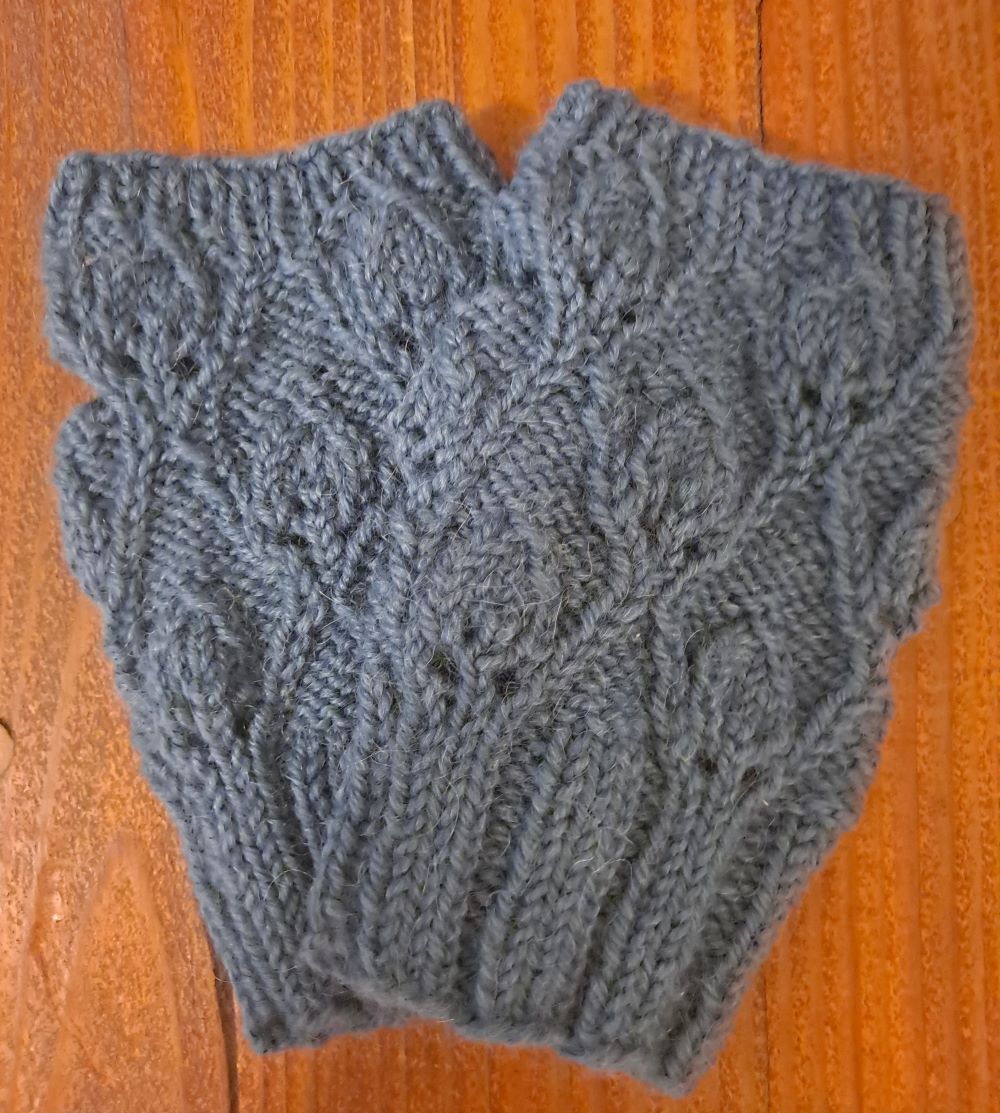
The yarn I used was Berroco Ultra Alpaca in color 62106 Pacific Blue,, and it’s a very pretty, soft yarn. I’m told by the friend I gave the Sylvie shawl to that it’s also comfortable and warm. Perfect for winter accessories. The yarn is described in the label as being “50% Super Fine Alpaca and 50% Peruvian Wool” so with that, along with the fact that Berroco is well established, you know it’s good quality.

But, I was a bit disappointed in how uneven some of the stitches were, and I couldn’t get it corrected. This would be with the stitches that border the center portion of the design. Like I said, I think a smoother yarn might have been better. I don’t typically have this much trouble with that kind of stitch.

The hat pattern gives directions for both the style I knit and a folded-over brim hat. The difference is merely more ribbing. I would have made the folded-over style, because I prefer that in a hat, but I wasn’t sure how much yarn I had left over. I am, however, happy with the style of hat I knit.

For both the hat and the mitts, I used the recommended needle size, which was an 8 for the hat and 7 for the mitts. And no, for anyone who’s been following my blog, I didn’t use Ewenicorn needles for the hat. I already had a couple of pairs of size 8 16″ circular needles and couldn’t justify buying any more. For that matter, I don’t know if the Ewenicorn needles come in that size. I didn’t dare look. It might have been too tempting.

Alina MittsFor the mitts, I did not do the thumbs. They give decent instructions for their method, but I’ve tried it before with some mittens and had very little success. So I left off the thumbs. I bound off the five stitches where the pattern would have you prepare for the thumbs and cast on those stitches in the next round.

One thing I learned about the mitts very quickly is it’s a lot easier to use five double pointed  needles than four. There are four repeats for the pattern and you can have one repeat on each needle, which is far better than trying to adjust the cable stitches on three needles. I did it that way at first and ended up with a lot of stitches on one needle.

These patterns are from SweaterBabe.com and are available for purchase online. The directions were clear and they had both written and charted instructions. I used the charts and they were clear and easy to follow. The Sylvie shawl I mentioned earlier was also a Sweater Babe pattern, and I’ve been happy with all of them. I plan to go back for more!

Knitting

Sylvie Shawl

I worked on this shawl primarily on my vacation, and was pleased with how quickly it knit up. Of course I didn’t knit in the nupps, which most certainly would have slowed down the process. I started to knit them, but decided it was more important to finish this project in a timely manner. It’s a gift I hope to give soon.

20230719_193235You can see that the lace pattern is very pretty even without the nupps. I was certainly happy with how it turned out. The bulk of the shawl is knit in stockinette stitch, with some seed stitch borders breaking it up. It’s a fairly easy pattern. The pattern authors–SweaterBabe–rated it as intermediate, and I agree with that rating.

I used Berroco Ultra Alpaca, and since I didn’t knit in the nupps I only needed four of the recommended five skeins. So now I’m searching for patterns for that last skein–and a good portion of the fourth. I didn’t add in the fourth skein until row six of the ribbing, which is the last thing you knit.

The color I used was 62106–Pacific Blue. The color in the featured photo is closest to the actual color; the close up of the lace pattern shows a very pretty blue, but it’s not the actual color of the shawl.

Once again I used an Addi Ewenicorn needle, size eight, 32″ circular, which is the recommended needle size for this pattern. I’m crazy about those Ewenicorn needles, but if you’re going to knit the nupps, I don’t recommend them for this pattern. You’ll want a lace point needle.

This is a pretty basic shawl, and overall I’m pleased with the result. It’s the perfect gift for my friend, who no doubt will appreciate it.

Knitting

Xianren Shawl

When my mom moved into assisted living, my brother cleared out all the belongings that wouldn’t fit into her new studio apartment. That was a lot of stuff, and unfortunately, it included all the winter wear I’d knit for her over the years. So now I’m replacing what’s missing.

This is the second piece of that process, and it turned out to be a bit unusual. The shawl is asymmetrical, starting out with four stitches on one end and finishing with 209 stitches at the other end. It gradually increases, so you end up with one side that covers really well and another that doesn’t. It isn’t the most practical shawl I could have made.

ShawlHowever, the cable pattern is really pretty. The picture I have here shows that pattern along with the finishing edge pattern. The shawl is featured in the Winter 2021/2022 issue of Vogue Knitting and it’s pattern #6, Xianren. Apparently that’s the name of a bridge in China, and I’m not sure what the connection is. Doesn’t matter, I suppose.

I used Malabrigo Rios yarn in color 645, Casapueblo. It’s 100% superwash merino wool and is yummy to knit with. It slides easily–but doesn’t slide off the needle when you don’t want it to. Speaking of needles, I used an Addi size 7 Ewenicorn needle. This is the second time I’ve used a Ewenicorn needle, and like I said before, I don’t know what it is about them, but I love it. It has a spiraling texture, like a unicorn’s horn.

While Vogue Knitting gave this pattern a difficulty rating of 3 out of 4, I don’t think it’s that difficult. Possibly the M1L increase was the reason for the strong rating, and that can be kind of a pain to do. The yarn might be tight around the needle, making it a challenge to knit that stitch. Still, once you’ve done it a few times it becomes second nature. The cable pattern was a simple 3/3 LC, and the rest of the knitting was stockinette or reverse stockinette.

The finishing was super simple. You bind off in the pattern and then weave all the ends in. Speaking of ends, I have no problem starting a new skein of yarn in the middle of the row, and it didn’t prove to be an issue with this pattern.

I didn’t block the shawl because I didn’t want to lose the ripple effect. The pattern calls for lightly steam-blocking if desired, and I understand why it’s optional. This may be the first knitted piece I didn’t block, and I don’t regret it.

Overall, I’m happy with the shawl. Like I said, it isn’t the most practical shawl because it doesn’t cover one side really well. I’d consider it more of a fashion piece. Still, I enjoyed knitting it and I’m pleased with the results.

Update: My concerns about the unusual shape of this shawl turned out to be unnecessary. My mom loves it and wears it with style.